The Surly Curmudgeon

YouTube icon button linking to Brian Hupp's YouTube Channel

Genesis 41 brings us at last to the revelation of God’s purpose in allowing Joseph to be sold into slavery – to put Joseph into a position in Egypt that allowed him to facilitate the rescue of Jacob’s family out of starvation in a regional famine. Ultimately, God used this survival of Israel through the famine to bring about the birth of Jesus of Nazareth the promised Messiah who was to rescue all mankind out of death in our sins.

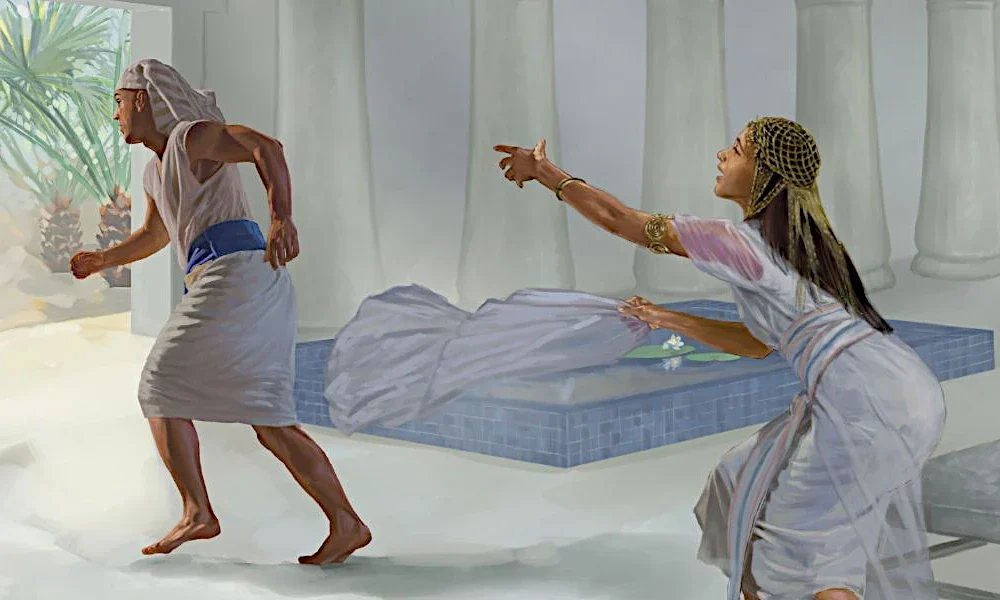
We return now to the story of Joseph’s slavery in Egypt. While serving as the manager of his master Potiphar’s household, Joseph resisted the temptation to sleep with Potiphar’s wife and ran away. But she falsely accused Joseph of attempting to sexually assault her, and Potiphar threw him into prison. While there, Joseph (by God’s power) correctly interpreted the dreams of two fellow prisoners. One was executed by Pharaoh. The other was returned to his place in Pharaoh’s service, but forgot about Joseph whom he left behind in the prison.

Genesis 38 makes a brief departure from the story of Jacob’s son Joseph’s life in Egypt to relate the somewhat distasteful story of Jacob’s son Judah’s sexual encounter with his widowed daughter-in-law Tamar whom he mistook for a cult prostitute. Although this story may be revolting to our modern sensibilities, it allows us to explore the ancient Hebrew tradition of levirate marriage under which the eldest surviving brother of a man who died childless was required to take his brother’s widow as wife and father offspring by her for his dead brother. More importantly, Perez – Tamar’s son by Judah – became the forefather of Jesus’ mother Mary and her husband Joseph in fulfillment of the prophecies about the coming Messiah and of God’s eternal plan of salvation for all mankind.

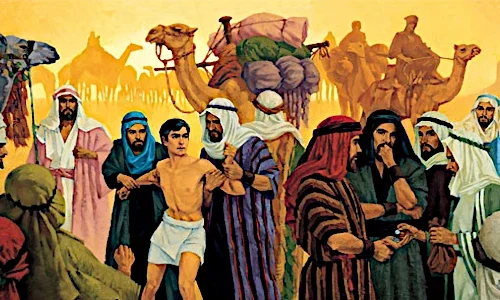
Genesis 37 begins the final major section of the book of Genesis – the story of Jacob’s second-youngest son Joseph who was sold into slavery in Egypt by his own brothers. Although the brothers had initially intended to kill Joseph, they decided to sell him as a slave instead. Despicable as the brothers’ maltreatment of Joseph was, their jealousy was due to their father Jacob’s favoritism of Joseph and his younger brother Benjamin – the sons of Jacob’s favorite wife Rachel – over the elder sons of Jacobs other wives. This favoritism caused trouble in Jacob’s family just as Jacob’s mother Rebekah’s favoritism of Jacob over his twin brother Esau had years before.

Yet all of the players in this little drama were unknowingly acting in accordance with God’s sovereign plan to use Joseph in Egypt to rescue the nation of Israel (Jacob) out of starvation in Canaan so that Jacob’s son Judah could become the forebear of King David and ultimately Jesus of Nazareth through whom God fulfilled His promise to Jacob’s grandfather Abraham that through his seed all the families of Earth would blessed.

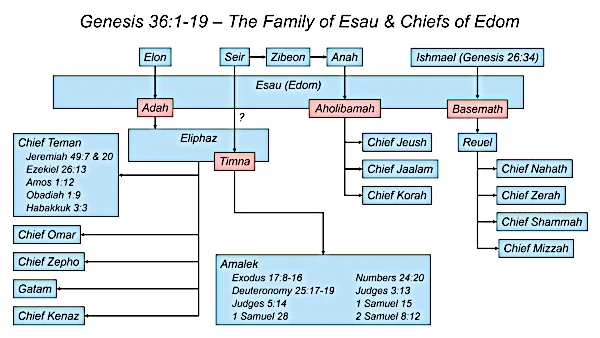
In Genesis 36 we find a brief aside into the lineage of Esau’s descendants and those of Seir the Horite in whose lands Esau went to dwell after separating from his brother Jacob after Jacob’s return from a twenty-year sojourn among their forefathers’ descendants in Paddan-Aram. These genealogies in Genesis 36 are found wedged between two major sections of the book of Genesis – the section we have just finished studying about Jacob’s life and the birth of his heirs who became the founding patriarchs of the twelve tribes of Israel, and the final section that we will take up next detailing the life of Jacob’s second-youngest son Joseph.

These family tree diagrams show the family relationships of Esau’s and Seir’s descendants listed in the Biblical text of Genesis 36 and 1 Chronicles 1:35-54. Men’s names are shown in blue. Women’s names are shown in pink.

Genesis 35 brings us finally to the end of Jacob’s return journey from Paddan-aram to his father’s house in Canaan. Following the despicable massacre of the men of Shechem, God called Jacob to return to Bethel (Luz) where He had appeared to Jacob in a dream 20 years before. There God reiterated Jacob’s renaming as Israel, and His promise to give the land of Canaan to Jacob and his descendants. From Bethel, Jacob continued toward his father’s house in Hebron, but along the way Rachel died giving birth to Jacob’s youngest son Benjamin.

Genesis 34 recounts one of the most deplorable events in all God’s Word – the rape of Jacob’s daughter Dinah and the horrific revenge taken by Jacob’s sons upon her rapist Shechem’s city.

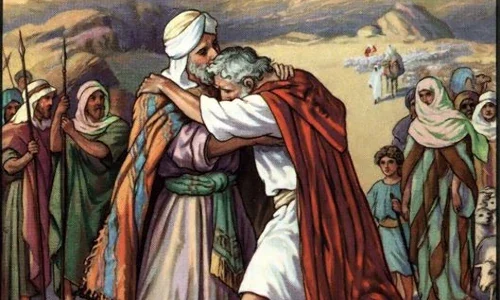
In Genesis 32-33 we look at the well-known story of Jacob wrestling with God who blesses him and renames him Israel. Afterward Jacob and his twin brother Esau meet and reconcile after a twenty-year estrangement. Esau then returns to his home in Seir while Jacob returns to Canaan and settles at Shechem.